ATI AT3000 Amplifier Review
Home Entertainment & Design Magazine
By Brent Butterworth
The 200 MPH Amplifier
With 2,100 watts of power and an elite circuit design, ATI's AT3000 is the audio equivalent of an extreme sports car.
Any product can be refined; the question is, do the refinements substantially improve the product? In some cases - increasing a car's horsepower, for example - the answer is usually "yes." In others - such as substituting filet mignon for cubed chuck in a pot of chili - the answer is, unequivocally, "no." With audio amplifiers, however, the answers are seldom so cut-and-dried.
Through the years, many electronics manufacturers have attempted to refine the audio amplifier through sundry means few non-engineers can comprehend. I have heard many excellent amplifiers that incorporate these refinements, but I can seldom attribute to them any specific character of sound or quality of improvement. Furthermore, some engineers consider most esoteric circuit enhancements a waste of time and resources.
There is one refinement, though, on which practically every authority, from the ultra-conservative "everything-sounds-the-same" engineer to the rarified audiophile, agrees: fully differential construction. Author G. Randy Slone, the expert who wrote High-Power Audio Amplifier Construction Manual, describes differential construction as the "Cadillac" of amplifier designs; consider this accolade the highest level of compliment and forgive his limited familiarity with luxury automobiles.
Intimidating as it may sound, fully differential construction is fairly easy to understand. A differential (or mirror-image) amplifier uses two identical amplifier circuits, where only one was used before. One amplifies the positive half of the audio signal; the other amplifies the negative half. This design cancels out noise that ordinary amplifiers would pass on to your speakers. It also operates at twice the speed of an ordinary amp. Of course, doubling up on circuits adds considerably to the cost of manufacturing, so fully differential construction is rare, found mainly in very high-end, audiophile-oriented amps.
Amplifier Technologies, Inc. has just introduced its first fully differential, or as ATI says, "Pure Balance" amplifier: the AT3000. ATI may be unfamiliar to you, but anyone who has visited a few good home theaters has probably heard an ATI amp, whether the amp bore the ATI logo or one of the many other brands built by ATI.
The AT3000 contains two to seven channels of amplification, enough for advanced, multi-channel surround-sound formats such as Dolby Digital EX and DTS ES-Discrete. Each channel produces 300 watts of power into an 8-ohm speaker.
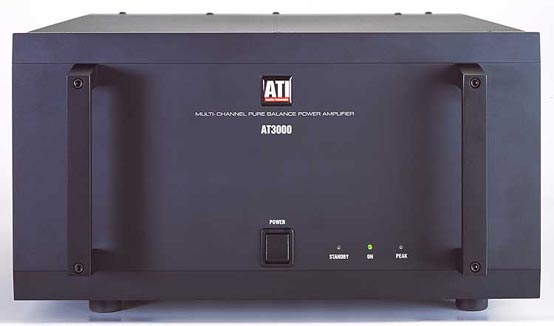
While no home theater aficionado ever feels his or her amplifier is quite powerful enough, the AT3000 is, for any conceivable room, speaker system or listening level, powerful enough. Your speakers will likely burn out before this amplifier does, and your ears will give out long before that. The image that keeps coming to mind is one of the AT3000 as an Olympic wrestler, slamming your speakers to the ground and holding them down for the count. The AT3000's 126-pound bulk certainly supports that notion.
Since a 20-amp AC socket is necessary for the seven-channel AT3000 to reach its full 2,100-watt output (ordinary 15-amp sockets supply a mere 1,800 watts), ATI supplies a power cord that will fit only into a 20-amp socket.
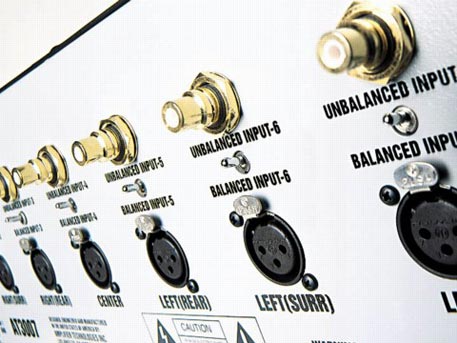
AT3000's aesthetic appeal is nonexistent; it is as basic as a Model-T Ford. The front panel has a power switch; the rear has the usual RCA-style input jacks and professional-type XLR balanced input jacks. Today, almost all large, multi-channel home theater amplifiers feature XLR balanced inputs, but most simply convert the signal back to unbalanced inside the amp, negating the earlier mentioned benefits of using a balanced connection. The Pure Balance construction keeps the signal balanced all the way to the speaker terminals, so you receive all of the full benefits of the XLR connection. The output connectors accept almost any type of speaker-wire termination.
Because of this amplifier's huge appetite for electrical current, AT3000's channels power up one at a time, so your lights will not dim when you turn the amp on. A short circuit or overload shuts the amp down without sending a damaging thump through your speakers. A special circuit monitors the action every eight seconds and returns power to the amp as soon as the short or overload is corrected. This design eliminates the fuses that, if they blow, will likely require a service call from your installer. According to ATI, the worst that can happen from an overload is that the circuit breaker on the back of the amp will be thrown; even the most technically inept user can flip the breaker switch back on.
The AT3000 does, in fact, sound great. It produces world-class bass, which comes as little surprise because bass reproduction has always been a strong point for ATI amps, and this is the company's most-powerful, best-engineered amp to date. The bass sounds well-defined at all pitches, and even the deepest, loudest pipe-organ and synthesized bass notes do not overwhelm the AT3000.The midrange impresses me most. Vocals, dialogue, saxophones, pianos, electric guitars - all sound extremely clear with none of the unnatural, strained sound I typically hear from lesser amplifiers. I find it difficult to distinguish the AT3000's midrange from that of two very high-end multi-channel amplifiers I have on hand.
The AT3000's treble sounds clear and clean, never distorted, emphasized or unnatural. The treble sounds slightly less present than that of the audiophile amps I cited above; as a result, its stereo imaging is subtly less dramatic. However, it produces considerably more power and somewhat better bass performance than either of those amps. In my opinion, only those whose tastes tend toward large, full-range, audiophile-oriented speakers like Revel Salons or Wilson WATT/Puppies would benefit greatly from exploring more rarified amplifiers.
Reviewing the AT3000 is like reviewing a sports car that can reach 200 mph. In the same way that a Car & Driver writer knows his or her readers will never really actually drive that fast, I am certain that you will never be able to fully experience the limits of the AT3000's enormous performance capacity.
DESCRIPTION
Two- to seven-channel audio amplifier with 300 watts per channel.
CONNECTIONS
Chassis-mounted RCA unbalanced and XLR balanced input jacks; five-way speaker-cable binding posts that accept bare wire, pins, spade connectors, banana plugs and double banana plugs; 1/8-inch mini-jack for auto turn-on/turn-off control from a surround-sound preamp/processor or a touch screen remote control system.
DIMENSIONS
9.8 x 17 x 21.5 inches (hwd); 19.1 inches installed depth in rack.