"Pure Balance"®
The differential drive amplifier
The engineering staff at ATI has been designing high performance multi-channel amplifiers for over 35 years. Many of their innovative products have become de facto standards and have repeatedly won top awards. This experience has culminated in the introduction of a series of multi-channel amplifiers utilizing differential design dubbed "Pure Balance"® to create amplifiers of truly balanced operation from input to output.
History
Differential drive amplifiers are relatively new to the audio industry but have been around for 50 years in analog telephone systems. The reasons for using differential design are to eliminate crosstalk with adjacent conversations, to lower noise and to improve the dynamic range on a conventional telephone. This technology is also used in the recording industry to lower noise, buzzes and other interferences that arise from low-level signals driven on long runs. Similar technology is being found more and more in high-end audio equipment to a greater or lesser degree.
What is a differential drive amplifier?
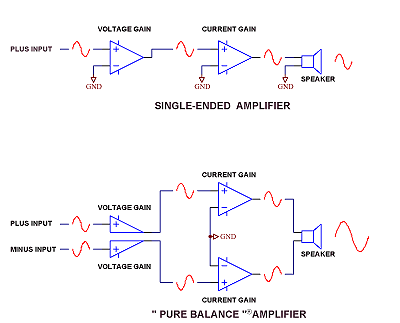
A truly differential drive amplifier, consists of two complete amplifiers for each channel: one + amplifier and - amplifier. The positive input signal is amplified by the positive amplifier and the negative input signal is amplified by the negative amplifier when a balanced signal is applied to the input. There is no ground reference since the output signal is derived from the combination of the positive signal and the negative signal. A differential drive amplifier is sensitive to the difference between the positive and negative input signals resulting in those signals common to the input being cancelled. The input stages of each channel of the amplifier are of differential design all on one substrate resulting in the reduction of hum and turn-on/turn-off pops. This is referred to as "common mode rejection".
Why is a differential drive amplifier superior?
By virtue of "common mode rejection", the "Pure Balance"® amplifier exhibits lower noise, lower distortion, and immunity to stray electronic fields and anomalies in the input signal from outside interference. The resulting benefit in music reproduction is more silence between each musical note. In home theater applications, the result is a deeper, cleaner soundstage. An apparently larger dynamic range results because of the enhanced silence between sounds. Clarity is improved significantly because of lower distortion and the differences between loud and soft passages are more pronounced. The Slew rate is doubled in differential drive amplifiers as compared to single-ended designs. The slew rate in high-end amplifiers has always been considered important. The highest possible slew rate is desirous, so having twice the slew rate is a significant benefit. A high slew rate allows for sharp attacks on all your transient frequencies resulting in more realistic sensations from either music or sound effects. Another virtue of the differential drive amplifier is that it requires only one-half the rail voltage for a given power output rating into 8 ohms as compared to a single ended amplifier. Reducing the rail voltage by one-half will allow the output transistors to work in a more linear fashion, thus improving the transient performance of the amplifier. This results in much richer transients in the music; cellos sound like cellos, flutes sound like flutes, clarinets sound like clarinets and acoustic guitar recordings will exhibit the same phenomenal richness as experienced at live concerts.
Summarizing benefits
- Lower noise
- Double the slew rate
- Apparent gain in volume
- Immunity to stray fields
- Lower distortion
- Reduction in all types of amplitude distortion
- Immunity to hum
- Better transient performance